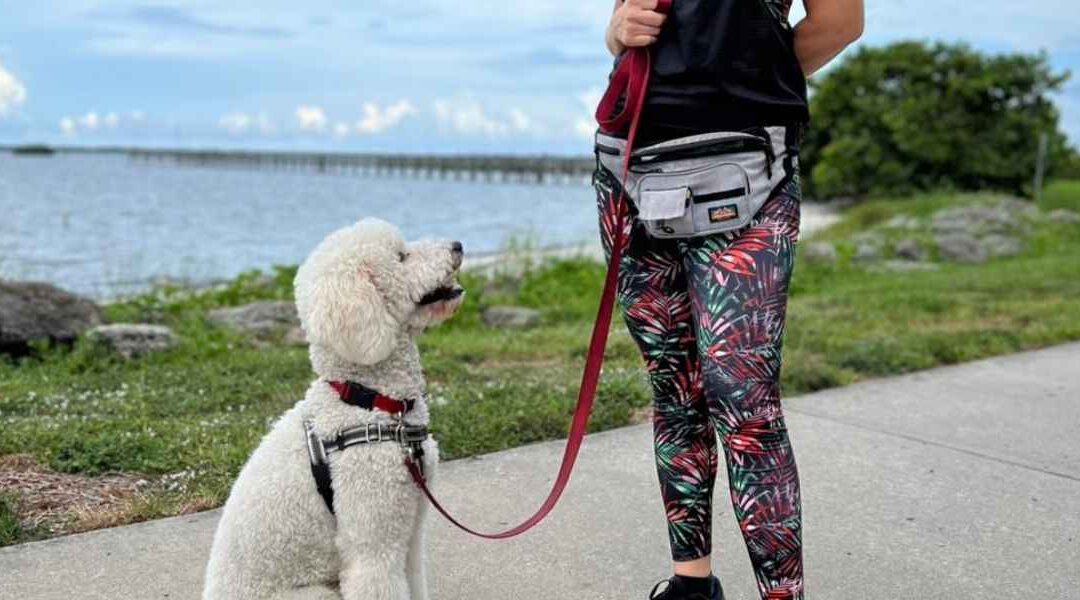
Halloween puppy training can help prevent doorbell chaos, jumping, fear, and unsafe escapes. Use these seven practical steps to prepare your puppy for costumes, visitors, and Halloween night.
You do not need to wait until Halloween night to find out how your puppy will respond. Short practice sessions can teach calm greetings, build comfort around unusual sights and sounds, and give your dog a safe place to settle. Begin your Halloween puppy training with the easiest version of each activity and increase the difficulty only while your puppy remains comfortable.
Start With the Doorbell at a Low Level
For many dogs, the doorbell predicts instant excitement. Practice when no guest is actually waiting. Play a recorded doorbell sound very quietly or have a helper tap once. Immediately guide your puppy to a simple activity such as finding a few treats on the floor, going to a mat, or looking at you.
Repeat only a few times, then stop. If your puppy barks continuously, will not take food, or cannot respond to a familiar cue, the exercise is too difficult. Lower the volume, increase the distance from the door, or practice without the sound. The goal is to build a calmer response through repetition.
Teach a Place to Settle
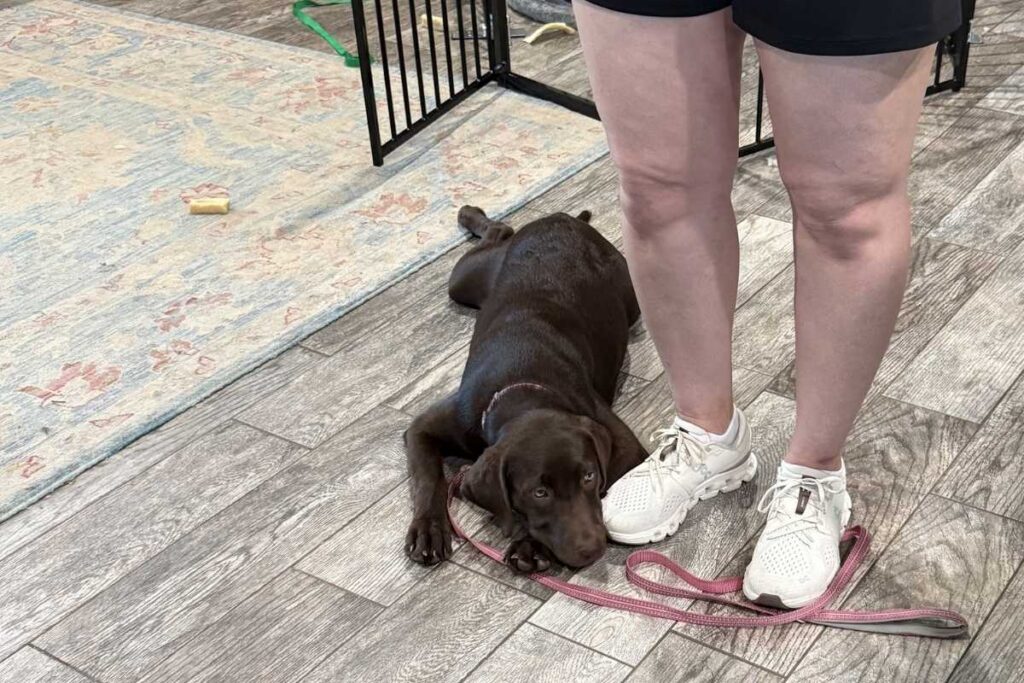
A mat, bed, crate, or quiet room can give your puppy a predictable place away from the doorway. Practice this location during ordinary moments before adding visitors. Reward your puppy for stepping onto the mat, lying down, and remaining there briefly while you move around.
Gradually add realistic pieces of the routine: walk toward the door, touch the handle, open and close it, and speak to a pretend visitor. Keep each step easy enough for your puppy to succeed. A baby gate or closed interior door can add useful distance. Choose a setup that prevents access to the open exterior door without frightening or isolating your puppy.
Practice Calm Greetings With One Helper
Begin with one familiar adult instead of a group. Ask the helper to enter quietly and ignore the puppy for a moment. Reward four paws on the floor, a sit if your puppy already knows it, or calm attention near you. If jumping begins, the helper can pause and turn slightly away while you create more distance and help the puppy reset.
Keep the first greeting short. Several successful ten-second practices are more useful than one long visit that becomes increasingly exciting. Puppies learn from the pattern they repeat, so plan the distance, rewards, and exit before the helper arrives.
Introduce Costumes Without Pressure
Costumes, hats, masks, and bulky decorations can make people look unfamiliar. During Halloween puppy training, place one costume item on the floor at a distance and let your puppy notice it. Pair calm observation with something your puppy enjoys. Later, a familiar person can hold or wear part of the costume briefly while standing sideways and allowing the puppy to choose whether to approach.
Do not corner your puppy, force an interaction, or repeatedly move a scary object toward them. Watch for avoidance, a tucked tail, trembling, frantic movement, repeated lip licking, or an inability to settle. Increase the distance and make the exercise easier when you see discomfort.
Prevent Door Dashing Before It Happens
Management matters while training is still developing. Use an interior gate, closed room, crate, or another secure barrier so the open front door is never your only line of protection. Make sure identification information is current and that everyone in the household understands the plan.
Practice waiting several feet from the door while it opens only a few inches. Reward your puppy for staying behind the boundary, then close the door and reset. Avoid testing the behavior with an unsecured exterior door. A rehearsed safety routine protects your puppy while the training becomes reliable.
Create a Comfortable Halloween Retreat
Some puppies will do best away from the activity. Set up a quiet space with water, comfortable bedding, and an appropriate enrichment item your puppy has used safely before. Reduce the sound of the doorway when possible. Check on your puppy regularly and provide normal bathroom breaks without taking them through a crowded entrance.
A retreat is not a punishment. It is a practical part of Halloween puppy training for a puppy who is tired, worried, or not ready for repeated greetings. You can continue practicing on quieter days without using Halloween night as the final exam.
Keep Holiday Hazards Out of Reach
Store candy, wrappers, glow products, electrical cords, and small decorations where pets cannot reach them. Review the ASPCA’s Halloween pet-safety advice for additional guidance. Chocolate and products containing xylitol can be dangerous to dogs. If you think your puppy swallowed something unsafe, contact your veterinarian or an animal poison-control service promptly rather than waiting for symptoms.
If your puppy wears a costume, make sure it allows normal movement, breathing, vision, and bathroom use. Supervise throughout and remove it if your puppy appears uncomfortable or starts chewing it. A festive bandana is enough for many dogs.
A 7-Day Halloween Puppy Training Plan
Day 1: Choose the mat, room, or gated area your puppy will use and reward a few calm visits there.
Day 2: Practice one quiet doorbell sound followed by an easy activity away from the door.
Day 3: Rehearse walking to the door and touching the handle while your puppy stays behind the planned boundary.
Day 4: Ask one familiar helper to complete a short, calm entrance.
Day 5: Introduce one costume item at a comfortable distance.
Day 6: Repeat the easiest successful exercise instead of rushing to a harder version.
Day 7: Review the plan with everyone in the household and prepare the retreat area.
When Your Puppy Needs More Support
Some puppies recover quickly from excitement. Others need a more gradual plan, especially if they are already fearful of visitors, react strongly to sounds, guard the doorway, or have a history of biting. Avoid staging difficult greetings on your own when safety is a concern. A qualified trainer can help you choose appropriate management and training steps. Your veterinarian can also help when fear or behavior changes may have a medical component.
Goldstar Puppy Academy helps families in Vero Beach and the Treasure Coast with practical, real-life Halloween puppy training through our puppy and dog training services. If your puppy struggles with doorbells, visitors, leash manners, or settling, call or text 772-388-7073 to schedule a free consultation. We will help you choose the right next step for your puppy and your household.
Once the back-to-school rush settles down and the family’s new routine becomes normal, many puppy parents notice a different challenge: the house is suddenly quiet for longer periods.
Home alone puppy training works best when independence is built gradually, with a predictable routine and realistic expectations for your puppy’s age.
Children are at school, adults are at work, and a puppy who enjoyed constant summer companionship is now expected to rest calmly alone. That transition does not always go smoothly.
Unexpected potty accidents, daytime barking, doorway chewing, pacing, crate resistance, and frantic greetings can all be signs that your puppy is struggling with the new routine.
At Goldstar Puppy Academy, we help families throughout Vero Beach, Sebastian, Fort Pierce, Port St. Lucie, and surrounding Treasure Coast communities teach puppies how to feel safe, confident, and settled when family members are away.
If your puppy is having a hard time being home alone, these practical steps can help you rebuild independence before temporary stress develops into a lasting habit.
Why Is My Puppy Suddenly Struggling When Left Alone?
Puppies do not automatically understand that being alone is safe. During summer, your puppy may have become accustomed to hearing people throughout the house, following the children from room to room, joining family activities, and receiving frequent attention.
When that activity disappears, your puppy experiences a major change without understanding why it happened—or when everyone will return.
This is especially common when:
The puppy spent most of the summer with family members.
Alone time increased suddenly instead of gradually.
Feeding, potty, or exercise times changed.
Crate practice became inconsistent.
The puppy has excess physical or mental energy.
Departures and arrivals have become highly emotional.
The puppy has never learned how to relax independently.
The goal is not simply to leave your puppy alone and hope they “get used to it.” The goal is to build independence in manageable steps your puppy can successfully handle.
Common Signs of Alone-Time Stress
Before changing your home alone puppy training routine, observe what your puppy does, when the behavior begins, and how long it lasts.
Potty-training regression
A puppy who was previously doing well may begin having accidents when left alone. Sometimes the puppy is being asked to wait longer than they can physically manage. In other cases, a disrupted routine or stress may contribute to the problem.
Daytime barking or whining
Barking can be caused by boredom, outside noises, frustration, attention-seeking, or distress. A camera can help you determine when the barking begins and what happens immediately beforehand.
Doorway, furniture, or household chewing
Chewing is normal puppy behavior, but the location and timing matter. Chewing near doors, windows, or exit points may happen when a puppy is focused on where the family disappeared. Management and training must work together.
Pacing and difficulty settling
A puppy who repeatedly circles, follows departure cues, pants, or moves from window to door may be having difficulty relaxing.
Frantic greetings
Jumping, barking, mouthing, spinning, and zooming when family members return may signal pent-up energy or overexcitement. Repeatedly rewarding frantic behavior with immediate attention can make it part of the reunion routine.
Your Seven-Step Home Alone Puppy Training Survival Plan
Use this home alone puppy training plan as a flexible framework, adjusting each step to your puppy’s age, temperament, and current comfort level.
1. Confirm that the schedule is realistic
Consider your puppy’s age, bladder control, feeding schedule, exercise needs, and experience with being alone. A young puppy cannot be expected to follow the same schedule as a mature dog. If the family will be away longer than your puppy can comfortably manage, arrange an appropriate midday potty and activity break.
2. Meet your puppy’s needs before leaving
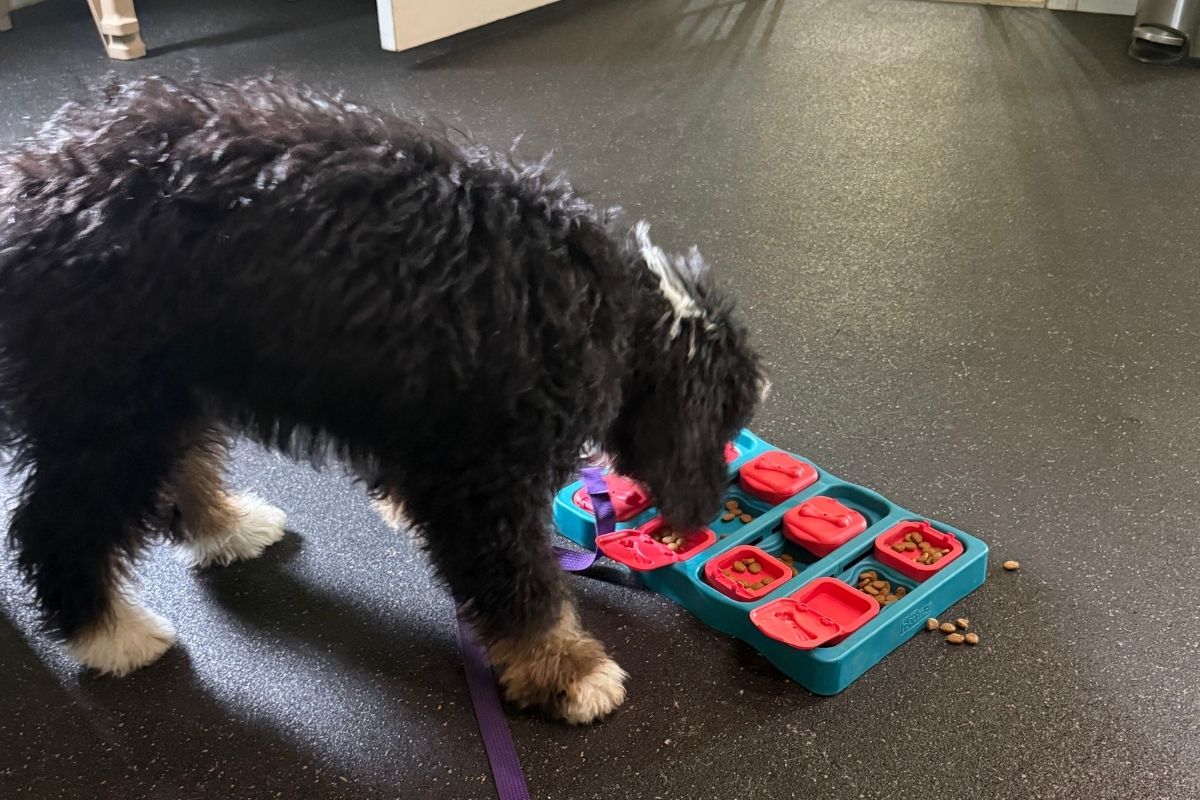
A thoughtful morning routine can make alone time much easier. Provide an outdoor potty break, age-appropriate movement, a short scent or training game, breakfast through enrichment, and one final bathroom opportunity before a calm departure.
Mental enrichment can help puppies settle more easily before alone time.
The objective is not to exhaust your puppy with frantic exercise. Combine movement, mental work, sniffing, and a few minutes of calm before leaving.
3. Create a safe, comfortable puppy zone
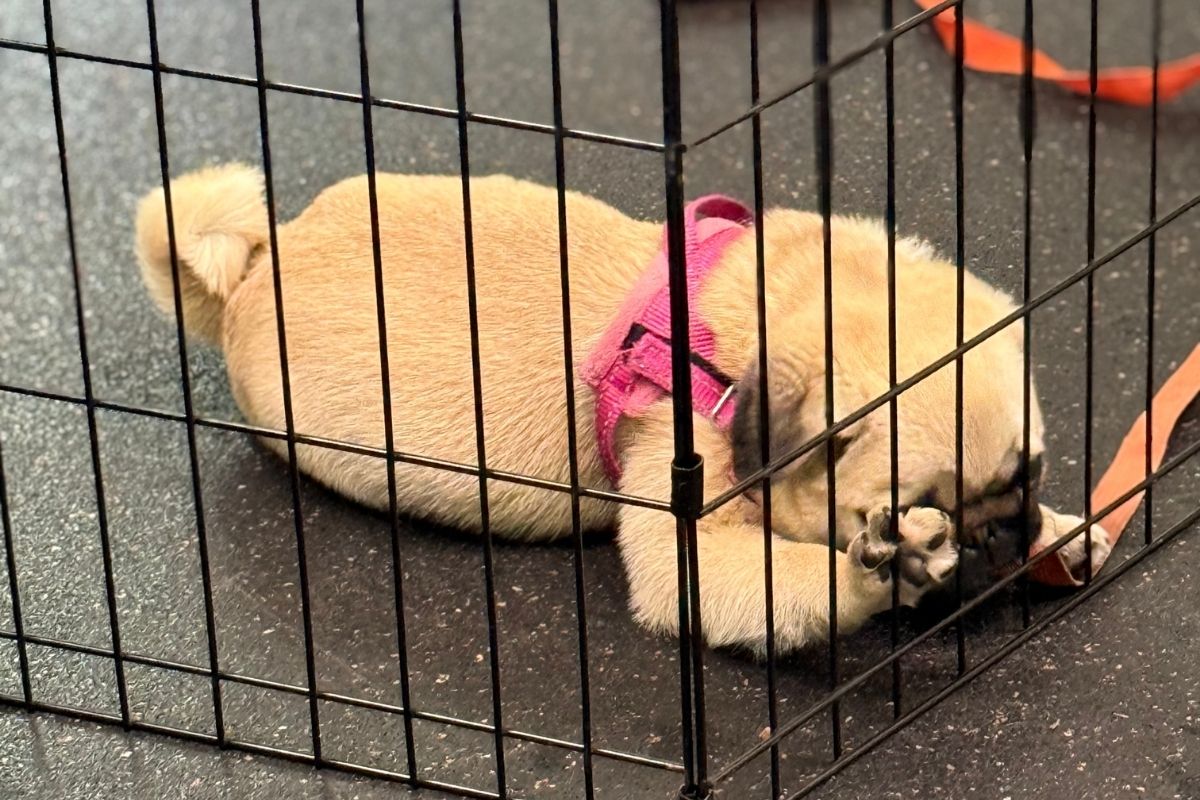
Your puppy should not have unrestricted access to the entire house before they are ready. Depending on the puppy, an appropriate setup might include a crate, exercise pen, gated puppy-proofed room, or another secure area.
Remove shoes, clothing, children’s toys, cords, food, cleaning products, and anything your puppy has previously chewed. Provide a comfortable resting area and a safe, puppy-appropriate enrichment option.
A comfortable puppy-safe space encourages calm, independent rest.
Crates can be valuable when introduced properly, but they should not be used to force a distressed puppy to remain confined longer than they can tolerate.
4. Practice independence while you are home
Short home alone puppy training sessions while you are nearby give your puppy repeated opportunities to succeed without becoming overwhelmed.
Encourage your puppy to rest behind a gate, in a playpen, on a place cot, or in the crate while you complete ordinary activities elsewhere in the home.
Start with short, successful sessions. Step into another room, close a door briefly, walk outside, or move the car, then return before your puppy becomes overwhelmed. Increase the duration gradually.
5. Make departure cues less important
Puppies quickly learn that keys, work shoes, bags, and backpacks predict someone leaving. Practice these actions when you are not going anywhere. Pick up your keys and sit down. Put on your shoes and make coffee. When it is time to leave, keep the goodbye calm and simple.
6. Use enrichment strategically
Food toys, snuffle mats, lick mats, and safe chews can create a positive association with quiet time. Choose enrichment based on your puppy’s age, size, chewing style, and experience, and supervise new items before leaving your puppy alone with them.
Remember that enrichment supports training; it does not replace it. A puppy experiencing significant distress may be too upset to eat or engage with a food toy.
7. Keep homecomings calm and structured
Enter calmly, put away your belongings, and take your puppy outside for a bathroom break. Offer attention when all four paws are on the floor. Then provide a structured outlet such as a sniffing walk, short obedience session, scent-search game, or place training.
What Not to Do When Your Puppy Struggles Alone
Effective home alone puppy training depends on preventing panic and helping your puppy practice calm behavior at a manageable pace.
Do not punish behavior you discover after returning
Your puppy cannot connect punishment with an accident or damaged object from earlier in the day. Clean the area, adjust management, and determine what allowed the behavior to occur.
Do not use a “cry it out” approach for severe distress
Brief protest and escalating panic are not the same thing. A puppy who attempts to escape, injures themselves, drools heavily, eliminates despite recently going outside, or remains distressed for an extended period needs a different plan.
Do not make sudden increases in alone time
Successfully resting alone for 15 minutes does not mean a puppy is ready for four hours. Build duration gradually and arrange support when the required absence exceeds your puppy’s current ability.
Do not assume more exercise will solve everything
Exercise is important, but an exhausted puppy has not necessarily learned how to feel safe alone. Independence, crate comfort, calmness, and settling are skills that must be practiced.
How Can You Tell Whether the Plan Is Working?
Look for gradual improvements rather than instant perfection:
Settling more quickly after you leave
Choosing to rest instead of pacing
Engaging with enrichment
Less barking or whining
Fewer potty accidents
Reduced chewing near doors and windows
Calmer greetings when the family returns
Greater comfort resting away from family members while everyone is home
A simple home camera can help you monitor progress. Keep brief notes about the duration, behavior, and anything that may have affected the day.
When to Get Professional Help
A customized home alone puppy training plan may be appropriate when gradual practice is not producing progress or your puppy shows signs of significant distress.
Contact a qualified professional if your puppy cannot settle, vocalizes for extended periods, repeatedly eliminates despite an appropriate schedule, attempts to escape, damages confinement areas, injures themselves, refuses high-value food, or shows intense pacing, panting, drooling, trembling, or panic.
Sudden behavioral changes can also have a medical cause. Consult your veterinarian if the behavior appears abruptly, is severe, or is accompanied by changes in appetite, thirst, digestion, urination, sleep, or general health.
Build Independence with Goldstar Puppy Academy
If your family needs support, home alone puppy training can be incorporated into a broader plan for everyday manners, settling, and confidence.
Learning to stay home alone is an important part of raising a confident family dog. Goldstar Puppy Academy offers customized help with crate resistance, potty-training setbacks, destructive behavior, overexcitement, leash manners, and difficulty settling.
Private puppy training
Personalized coaching can help your family create an appropriate routine, improve crate and place skills, and practice independence in manageable steps.
Day School
For dogs who are a suitable fit, Goldstar Day School provides structured activity, supervised socialization, enrichment, and opportunities to practice calm behavior. New families begin with a free phone consultation, followed by an assessment and trial day or trial days. Enrollment is selective so Goldstar can protect the safety and comfort of its existing alumni dogs.
Puppy Sleepaway Camp
For puppies who need a more immersive training foundation, Sleepaway Camp provides consistent practice with everyday manners, settling, confidence, and household routines.
Help Your Puppy Feel Safe When the House Gets Quiet
Consistent home alone puppy training can help your puppy learn that quiet time is safe and that family members always return.
Your puppy is not being difficult on purpose. They may simply need a clearer routine and more gradual practice with independence.
Goldstar Puppy Academy serves families throughout Vero Beach, Sebastian, Fort Pierce, Port St. Lucie, and surrounding Treasure Coast communities.
As summer winds down and the back-to-school rush begins, family schedules undergo a sudden, dramatic shift. Morning alarms ring earlier, breakfast becomes fast-paced, and house doors close for long stretches during the day. While human family members adjust to new calendars, puppies and young dogs are often left feeling confused by the sudden change in environment.
At Goldstar Puppy Academy, our expert dog trainers across Vero Beach, Sebastian, Fort Pierce, and Port St. Lucie see a common trend every fall: puppies who were thriving all summer suddenly experience setbacks in potty habits, crate confidence, barking, or destructive chewing.
The good news? You can prevent behavioral slide with a proactive Back-to-School Puppy Reset. Here is how schedule changes impact your dog's daily behavior and how to keep your training on track.
5 Ways Schedule Changes Impact Your Puppy's Behavior
Puppies thrive on consistency, predictability, and familiar routines. When the household dynamic shifts from constant summer company to quiet, empty weekdays, your pup may express their confusion in several common ways:
Potty Training Regression: Longer stretches alone and shifted morning walk times can disrupt established bathroom schedules.
Separation Anxiety & Excessive Barking: Going from 24/7 family attention to hours of silence can spark demand barking, whining, and pacing.
Destructive Chewing: Boredom is a puppy’s biggest trigger. Without structured physical and mental outlets, household items often become targets.
Crate Reluctance: If crate practice was relaxed over the summer, sudden extended periods in the crate can cause resistance.
Hyperactivity at Reentry: When kids return home after school, pent-up energy often erupts into jumping, mouthing, and frantic zoomies.
Your 5-Step Back-to-School Puppy Reset Strategy
Implementing a structured daily rhythm now will help your pup feel secure, calm, and well-mannered throughout the entire school year:
1. Adjust Feeding & Potty Routines Gradually
Don't wait for the first day of school to alter your puppy's schedule. Gradually shift feeding times, morning walks, and final potty breaks 10 to 15 minutes earlier each day to align seamlessly with your official fall departure time.
2. Build Independence (Even While You're Home)
If your puppy spent all summer shadowing family members from room to room, practice short periods of solo downtime now. Give your pup a high-value chew, stuffed KONG, or lick mat in their crate or playpen while you work or get ready in another room.
3. Upgrade Morning Mental Stimulation
A mentally satisfied puppy sleeps peacefully while the family is away. Before heading out the door, swap standard food bowls for interactive puzzle feeders, snuffle mats, or a quick 5-minute focus training game to burn brain power.
4. Keep Departures & Arrivals Calm
Dramatic goodbyes and high-energy afternoon reunions signal to your puppy that your absence is a stressful event. Keep departures low-key. When coming home, wait until your puppy has all four paws calmly on the floor before giving affection.
5. Channel After-School Energy into Positive Habits
If your family participates in our local After-School Club or daily family activities, teach kids how to interact appropriately with the puppy. Instead of high-pitched wrestling—which triggers puppy biting—encourage structured games like fetch, scent hide-and-seek, or practicing basic commands for treats.
Need Professional Support for Your Puppy's Fall Routine?
If your puppy is struggling to adapt to schedule shifts, experiencing crate distress, or regressing in potty habits, early intervention prevents temporary setbacks from becoming permanent adult behaviors!
At Goldstar Puppy Academy, we offer customized puppy training programs—including private in-home coaching and our popular Puppy Sleepaway Camp (Board & Train)—serving families in Vero Beach, Fort Pierce, Port St. Lucie, and Sebastian.
Adding a new dog to your family is an exciting milestone, but finding the right fit requires more than falling in love with a cute puppy picture or a fictional dog in a book or movie. Every dog breed carries unique energy levels, exercise needs, temperament traits, and health considerations.
At Goldstar Puppy Academy, our expert puppy trainers in Sebastian, Vero Beach, Fort Pierce, and Port St. Lucie see many soon-to-be dog owners asking: "How do I choose the right dog for my family?" Here is a practical guide to help you evaluate your lifestyle, space, and schedule to make the best choice for a lifetime of happiness.
Key Lifestyle Factors to Consider Before Getting a Dog
The best human-canine matches are built on energy and personality compatibility rather than looks alone. Before bringing a new pup home, evaluate these essential areas of your daily life:
1. Energy Level and Personality
Some breeds thrive on high-intensity outdoor activities, long runs, and daily mental challenges. Others are content with a daily walk and plenty of relaxation. Be honest about your current activity level and choose a dog whose energy matches your actual daily routine—not the lifestyle you hope to have someday!
2. Time Commitment and Work Schedule
Puppies and adult dogs require daily time, attention, exercise, and structured training. Dogs should not be left confined in a crate for 12+ hours a day. Even after a long or exhausting workday, your dog will still need exercise, mental stimulation, and quality time with you.
3. Living Space and Housing Restrictions
Consider your current living setup. A high-energy 90-lb Retriever in a small 600-square-foot apartment can be challenging without frequent trips to local parks. If you rent, keep in mind:
Pet deposits and monthly pet rent fees
Breed or weight restrictions imposed by landlords or HOAs
The need for quiet, well-mannered behavior in close-quarters living
4. Family Dynamics and Young Children
Raising a puppy alongside babies or young toddlers requires a tremendous amount of supervision and management. Puppies explore the world with their mouth, leading to sharp puppy teeth, nipping, and jumpy behavior that can easily startle young kids.
5. Long-Term Travel and Career Requirements
If your career requires frequent travel or long temporary relocations, consider the impact on your dog and family. Boarding fees or relying on family members to manage pet care can quickly add up and create extra stress.
Budgeting for a Dog: Beyond the Purchase Price
The average dog lives 10 to 15 years, making pet ownership a significant long-term financial commitment. Beyond initial adoption or breeder costs, remember to budget for:
Routine & Emergency Vet Care: Annual checkups, vaccinations, and unexpected illness or injury.
Parasite Prevention: Monthly heartworm, flea, and tick preventatives—essential in Florida’s humid climate.
Professional Training: Investing early in professional puppy training or board-and-train prevents costly behavioral challenges down the road.
Raise the Dog of Your Dreams with Goldstar Puppy Academy
Choosing the right puppy is just the first step—raising them into a confident, polite, and well-behaved adult dog is where the magic happens! Whether you want a dog who rests calmly under your outdoor table at a local cafe or walks politely by your side through neighborhood parks, early training makes all the difference.
At Goldstar Puppy Academy, we offer customized puppy training programs—including private coaching, group practice classes, and our popular Puppy Sleepaway Camp (Board & Train)—serving dog owners in Sebastian, Vero Beach, Fort Pierce, and Port St. Lucie.
Ready to give your new pup the best start in life?
Ever wonder how some dogs manage to lie calmly at your feet at a noisy outdoor cafe or settle peacefully on a blanket in the middle of a bustling airport terminal? Raising an "adventure dog"—a pup you can take anywhere on the Treasure Coast and beyond without stress or embarrassment—is all about early training and smart socialization.
Today, we are shining the Client Spotlight on one of our favorite Goldstar grads: Lola, an adventurous little Havanese puppy, and her dedicated parents!
The Challenge: Setting a Travel-Loving Puppy Up for Success
Within two weeks of bringing Lola home, her owners reached out to Goldstar Puppy Academy. As first-time dog parents who travel frequently between Florida and the Northeast—and love hosting dinner parties at home—they knew they needed a puppy who could handle new environments with confidence and poise.
They didn't just want basic obedience; they wanted a lifelong companion who could navigate life's adventures smoothly right by their side.
The Solution: Goldstar's Puppy Sleepaway Camp (Board & Train)
To give Lola the absolute best foundation, she enrolled in our premier Puppy Sleepaway Camp (Board & Train). During her stay in trainer Gerry-Anna's home, Lola was gently introduced to new environments, sights, sounds, and balanced animals, while mastering foundational life skills such as:
Rock-Solid Recall: Coming when called, even around exciting distractions.
The "Place" & Settle Command: Learning to relax quietly on her mat on cue.
Polite Manners: Mastering "Sit", "Leave It", and doorstep boundaries.
Following her board-and-train stay, Lola’s parents continued working with Goldstar through custom coaching to generalize her manners in real-world settings—including public parks, outdoor restaurant patios, and busy travel hubs.
The Real-World Result: 9-Month-Old Lola at Newark Airport
The true test of training comes in the real world—and Lola passed with flying colors!
At just 9 months old, Lola took her very first airplane flight. After remaining calm in her carrier under the seat throughout the flight, she arrived at Newark Airport during peak travel rush.
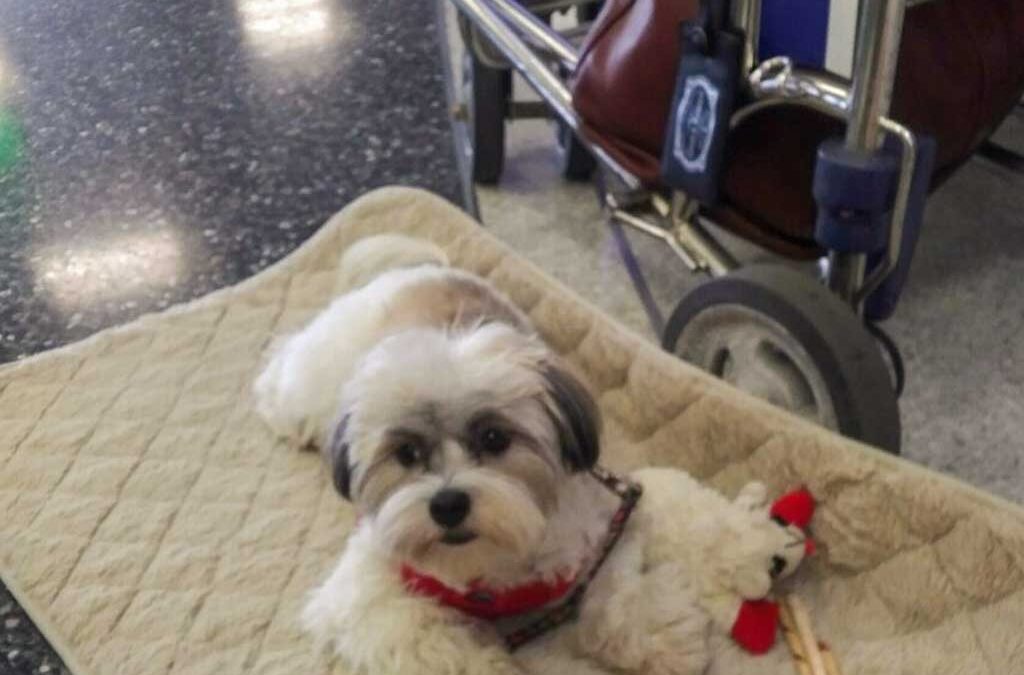
While crowds of travelers and rolling suitcases bustled around her in the middle of baggage claim, Lola quietly laid down on her travel mat and took a calm nap. No whining, no barking, and no anxiety—just total confidence and trust!
When they arrived at their northern home—a completely unfamiliar location for Lola—she went straight to her mat and rested peacefully after the long journey.
Why Early Puppy Training Pays Off for Life
Many puppies her age would be completely overwhelmed by airport noise and crowds, leading to stress for both the dog and the owner. Because Lola's parents invested early in structured board-and-train and consistent habit building, they set Lola up for a lifetime of stress-free travel and happy adventures.
Even when traveling thousands of miles away, Lola's family stays connected with Goldstar Puppy Academy through our virtual coaching sessions to ensure her manners stay sharp wherever life takes them!
Want an Adventure-Ready Puppy of Your Own?
Whether you're located in Vero Beach, Fort Pierce, Port St. Lucie, or Sebastian, you don't have to leave your pup behind or stress over chaotic behavior in public. With the right foundation, your puppy can become the polite, relaxed companion you love taking everywhere!